Number -
the symbols used to denote the natural numbers. 0, 1, 2, 3, 4, 5, 6, 7, 8, 9
Whole numbers
Whole numbers are the numbers starting at
0
0
and counting up forever:
{0,1,2,3,4,5,6,7,8,9,10,11...}
left brace, 0, comma, 1, comma, 2, comma, 3, comma, 4, comma, 5, comma, 6, comma, 7, comma, 8, comma, 9, comma, 10, comma, 11, point, point, point, right brace
Key idea: Whole numbers don't include negative numbers, fractions, or decimals.
Integers
Integers are just like whole numbers, but they also include negative numbers:
left brace, point, point, point, minus, 5, comma, minus, 4, comma, minus, 3, comma, minus, 2, comma, minus, 1, comma, 0, comma, 1, comma, 2, comma, 3, comma, 4, comma, 5, point, point, point, right brace
Key idea: Like whole numbers, integers don't include fractions or decimals
(..., - 2, - 1, 0, 1, 2, ...)
Numerals -
the symbols used to denote the natural numbers. The Arabic numerals 0, 1, 2, 3, 4, 5, 6, 7, 8, 9 are those used in the Hindu-Arabic number system to define numbers.
Natural Numbers -
the set of numbers, 1, 2, 3, 4, 5, 6, 7, 8, 9, 10, 11, 12, 13, 14, 15, 16, 17,....., that we see and use every day. The natural numbers are often referred to as the counting numbers and the positive integers.
Whole Numbers -
the natural numbers plus the zero.
Rational Numbers -
any number that is either an integer "a" or is expressible as the ratio of two integers, a/b. The numerator, "a", may be any whole number, and the denominator, "b", may be any positive whole number greater than zero. If the denominator happens to be unity, b = 1, the ratio is an integer. If "b" is other than 1, a/b is a fraction.
Fractional Numbers -
any number expressible by the quotient of two numbers as in a/b, "b" greater than 1, where "a" is called the numerator and "b" is called the denominator. If "a" is smaller than "b" it is a proper fraction. If "a" is greater than "b" it is an improper fraction which can be broken up into an integer and a proper fraction.
Irrational Numbers -
any number that cannot be expressed by an integer or the ratio of two integers. Irrational numbers are expressible only as decimal fractions where the digits continue forever with no repeating pattern. Some examples of irrational numbers are 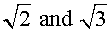
Transcendental Numbers -
any number that cannot be the root of a polynomial equation with rational coefficients. They are a subset of irrational numbers examples of which are Pi = 3.14159... and e = 2.7182818..., the base of the natural logarithms.
Real Numbers -
the set of real numbers including all the rational and irrational numbers.
Irrational numbers are numbers such as 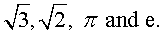 Rational numbers include the whole numbers (0, 1, 2, 3, ...), the integers (..., - 2, - 1, 0, 1, 2, ...), fractions, and repeating and terminating decimals.
Comments
Post a Comment